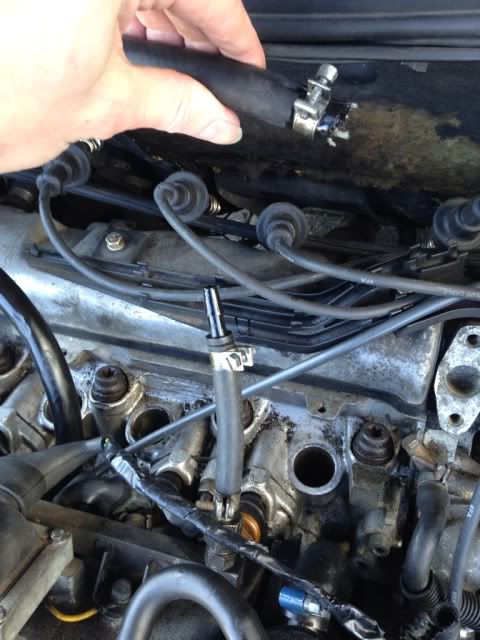
Here's a photo - the disconnected one is feed or return?
Thanks!
M


I can assure you Malcolm, that it does not do that on my BX GTi with the Motronic 3.1 injection system. With the feed disconnected from the rail, no petrol emanates from the pipe until you crank and then it comes out in spurts.citronut wrote:the pump dose run till it gets up to system pressure/a few seconds, then stops till you crank the engine
regards malcolm
i dont know for sure if Motronic reacts any different to other injection systems,Way2go wrote:I can assure you Malcolm, that it does not do that on my BX GTi with the Motronic 3.1 injection system. With the feed disconnected from the rail, no petrol emanates from the pipe until you crank and then it comes out in spurts.citronut wrote:the pump dose run till it gets up to system pressure/a few seconds, then stops till you crank the engine
regards malcolm
Cranking pressurises the rail and after a start, the ECU/relays take over. (Other injection systems may behave differently)

They all (multi-point rail) hold pressure between engine off and restarting which is why even in Haynes they warn you to depressurise the system before disassembly. The pump does not run under ignition live alone without a running engine.citronut wrote:i dont know for sure if Motronic reacts any different to other injection systems,Way2go wrote:I can assure you Malcolm, that it does not do that on my BX GTi with the Motronic 3.1 injection system. With the feed disconnected from the rail, no petrol emanates from the pipe until you crank and then it comes out in spurts.citronut wrote:the pump dose run till it gets up to system pressure/a few seconds, then stops till you crank the engine
regards malcolm
Cranking pressurises the rail and after a start, the ECU/relays take over. (Other injection systems may behave differently)
but maybe yours holds its pressure between engine off and re/starting
regards malcolm
The LE Jetronic electrical system is controlled by a single tachometric system relay with one pair of contacts. The tachometric type relay is energised from a speed signal provided by the ignition system. Without the speed signal the relay will not function.
A permanent voltage supply is made to relay terminal 30 from the battery positive terminal. Once the ignition is switched on, voltage is applied to the fuel injection relay at terminal 15. When the engine is cranked upon the starter, cranking voltage is applied to relay terminal 50. The relay windings are energised, the relay contacts close and voltage is output at relay terminal 87 and 87b (sometimes labelled 87a). Voltage is thus applied to the ECU at terminal 9, the fuel pump, AFS, TS and AAV.
When the engine speed rises above 400 rpm, a speed signal to terminal 1 of the relay from the ignition coil terminal number 1 holds the relay contacts energised. If the engine speed falls below 400 rpm, the relay will be de-energised and the relay voltage output will cease. The engine will stop.
When the ignition is switched on, the relay winding is momentarily energised which closes the relay contacts and connects terminal 30 to terminal 87b or 87 (varies according to model), thereby providing voltage to the fuel pump circuit. After a moment the circuit opens and the pump stops. This brief running of the fuel pump allows pressure to build within the fuel pressure lines, and provides for an easier start.
The relay contacts will then remain open until the engine is cranked or run. Once the relay receives a cranking signal from the starter circuit, the winding will again be energised by the ECU, and the fuel pump will run until the engine is stopped.
I don't know about BX's but low pressure returns are generally bigger bore than higher pressure feeds?Way2go wrote:The feed is the thicker pipe usually that fits to your right of the rail. The return comes off the other end of the rail through the pressure release.
Ah, so this is one of the differences then between the Motronic and Jetronic.mat_fenwick wrote:After a moment the circuit opens and the pump stops. This brief running of the fuel pump allows pressure to build within the fuel pressure lines, and provides for an easier start.
The relay contacts will then remain open until the engine is cranked or run.
