Well yes - quite confusing if you dont know the secrets

First off : the handbook diagram shows a standard (non-turbo) diesel. This is quite different from your turbo diesel engine with the intercooler laying flat upon the engine top.
In principle - yes these 2 engine types are similar, but realities are lots & lots of largr and minr differences.
Hence the mis-leading handbook description.
This is however very common to any car handbook you get hold of - unless it stricltly coversr the precise model & engine variant you have.
Add to this the on-going modfiicatons on the factory to the car - after the handbook is printed.
A) you found your coolant expansion bottle allright where you top up the coolant if necessary
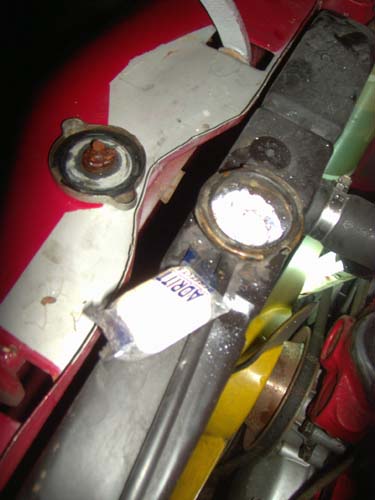
B) the 2 pictures from the radiator with "bleed" screws - they are in fact bleed screws. They twist out readily with handforce only, but might of course bind a bit from longterm closing. They only need 1-1.5 turn to come out and they have a simple rubber O-ring for sealing.
C) the white plug on bottom of the gearbox is simply a blind (welsh) plug sealing off a non used hole for the clutch atuator rod.
It may actually be a protector cap for the end of the rod if fitted.
Ths is because the same gearbox comes with 2 dofferent types of clutch actuator arm depending on factory production runs.
Meaning : dont touch this plug as it will not drain any fluid.
D) 2 identical plugs on engine block ? Hmm. Cant recognise these from my own turbo diesel. I may never have noticed them, but they are certainly not intended for use in any regular service work. Likely they are blinded off drilling ways from production. Either for coolant or oil ways.
E) "and ths little cap under the radiator" - is a NO-NO-NO

Dont touch.
This is the aircon system filler plug.
F) "Talking about the cylinder block, the handbook points to this thing, which I don't know about what it does: "
If you mean the light alloy thingie with a few rubber coolant hoses conected - then it is the thermostat housing.
Exactly in center of the picture - right above the stud where the small elbw connects - there is Hex-insex screw with an ever so small copper washer under it. This is the coolant air bleeder for the highest pont on the engine.
Be very patient wih this screw as it may snap the moment you apply forces to it

Use a small hammer and tap the screwhead several times trying to dislodge it from any corrosion. The use a hexkey to unwind it. Lube the threads with copper or alu non-stick paste.
To drain the cooling system "properly" you remove the plastic bleeders from the radiator, the cap from the expansion bottle and the screw mentioned above.
You may have a similar hex-screw behind the cylinder head, accessible when you unclip the frame with rubber from the intercooler.
This frame is just a pressfit down onto the intercooler.
There is no other "roper" way f draining- except it wil be advantageous to unclip the large top & botto hoses hoses from the rad.
This makes it very easy flushing both engine and rad- both reverse and forward flushing - using a garden hose.
If you want a cleaner cooling system - then use one of the prooven coolant cleaners available from car-shops.
Or purchase a large botte of 2.5L vinegar and pour into the cooling system - top up with clean tap water - and run for 3-5 weeks.
Cheap, safe and a very good smelling indicator of any leaks
C U / Anders - '90red16riBreak - '91GrisDolment16meteor - Project'88red19trsBreak
dead cars : '89white 16RS - '89antrasitTRDturboEst - '90white19triBreak





 I changed the cambelt, HP belt, water pump, idler and tensioner, diesel filter and coolant liquid.
 It's a great feeling of satisfaction, knowing that you've done the job well yourself (and saved money!)
 Now where is the edit facility when you need it?


