Bugger. Although I suspect it will still be Okish, as the easiest current path to earth is via the dipped beam filament of the second bulb. The path to earth via both main beam filaments will have almost twice the resistance (assuming 55/60w bulbs) so will see less current. Have to work out resistances to see whether it's an issue. Hmmm.
Don't spend too much time on it, but if we do work something out then I will definitely have to put it in after all this!
Headlamp Modifications
-
mat_fenwick
- Moderator
- Posts: 7330
- Joined: Tue Sep 20, 2005 4:08 pm
- Location: North Wales
- x 22
-
electrokid
- 1K Away
- Posts: 1764
- Joined: Fri May 09, 2008 2:14 pm
- Location: Woking
Hahahaha - I had a feeling your next reply would start with something like thatBugger.

I have to admit defeat myself at this stage - I have a circuit that should work but with 6 relays...
And I've spent most of the evening trying to find out how to use Ipswitch with my new (well 2 years ago anyway) webhost so my brain is a bit fried. I'm finding it hard to get my brain serviced now the local Woolworths has closed
... so here's my first attempt at posting a picture...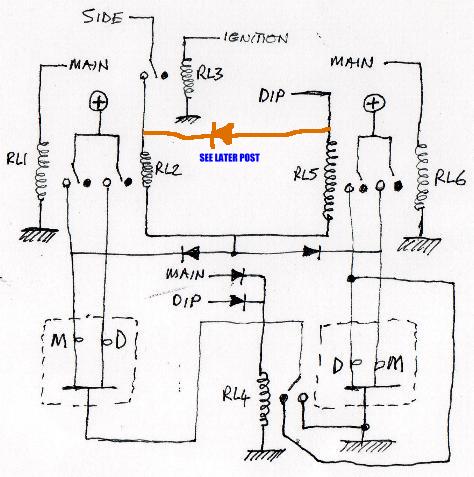
1992 BX19 TGD estate 228K Rusty - SORNed
2002 C5 HDi SX estate
2002 C5 HDi SX estate
-
electrokid
- 1K Away
- Posts: 1764
- Joined: Fri May 09, 2008 2:14 pm
- Location: Woking
PHEW !
Looks as though that works ! !
I'll do some more work on it tomorrow.
My natural inclination of course is to use power FETs and all sorts of clever electronicy stuff - but standard relays etc can be bought anywhere if there's a problem and it's far from home.
I learned this lesson the hard way - 1967 I was on the Isle of Man complete with my 1950 Morris Minor - the sticky-out indicators had been replaced with electronic flashing ones designed and built by yours truly - a fuel can in the boot wore away the insulation on a carelessly place wire in the boot - shorted out - and blew an OC35 transistor. No more indicators and no OC35s on the IoM that I could find.
Bulbs are funny things - their resistance is in milliohms until they get hot - any cct (including some of mine before I twigged) that has the 2 main beam filaments still connected will have a bright light one side and a very dim one the other.
I notice that the BX has a little control box by the OS headlamp - might be worth digging into.
Looks as though that works ! !
I'll do some more work on it tomorrow.
My natural inclination of course is to use power FETs and all sorts of clever electronicy stuff - but standard relays etc can be bought anywhere if there's a problem and it's far from home.
I learned this lesson the hard way - 1967 I was on the Isle of Man complete with my 1950 Morris Minor - the sticky-out indicators had been replaced with electronic flashing ones designed and built by yours truly - a fuel can in the boot wore away the insulation on a carelessly place wire in the boot - shorted out - and blew an OC35 transistor. No more indicators and no OC35s on the IoM that I could find.
Bulbs are funny things - their resistance is in milliohms until they get hot - any cct (including some of mine before I twigged) that has the 2 main beam filaments still connected will have a bright light one side and a very dim one the other.
I notice that the BX has a little control box by the OS headlamp - might be worth digging into.
1992 BX19 TGD estate 228K Rusty - SORNed
2002 C5 HDi SX estate
2002 C5 HDi SX estate
-
mat_fenwick
- Moderator
- Posts: 7330
- Joined: Tue Sep 20, 2005 4:08 pm
- Location: North Wales
- x 22
Thanks. What I'll probably do tomorrow is print it out a couple of times, and use a red pen to show the current paths in the different situations. I'll build the circuit off the car first, then I can just put the whole assembly in as a unit once I know it works.
Relays also have the advantage that I understand them completely, and can hear them operating. I'm still not sure I fully trust those new fangled transistor things!
Relays also have the advantage that I understand them completely, and can hear them operating. I'm still not sure I fully trust those new fangled transistor things!

1993 1.9 TZD Turbo Estate
1996 3.9 V8 Discovery
1993 VW LT35 campervan
1985 Hyundai Stellar V8
2016 Hyundai iLoad
-
Mike E (uk)

- 1K Away
- Posts: 1115
- Joined: Sun Aug 14, 2005 9:10 am
- Location: High Wycombe, Bucks
- x 1
2 bulbs inseries gives 1/4 the normal power in each bulb, which is probably similar to dim dip intensity.
But I am puzzled why you are bothering to try and keep the dim-dip at all.
I have never missed having it,after I removed it- and modern cars don't appear to have it anyway.
The wiring without it is so much simpler, plus I would not want to run bulbs in series because when one fails open circuit, both bulbs go out.
The simplicity thing wins for me though,my circuit uses 2 relays. If it goes wring I can fix it without much effort.
Plus the easier it is to fit, the more likely you are to fit it !
Mike
But I am puzzled why you are bothering to try and keep the dim-dip at all.
I have never missed having it,after I removed it- and modern cars don't appear to have it anyway.
The wiring without it is so much simpler, plus I would not want to run bulbs in series because when one fails open circuit, both bulbs go out.
The simplicity thing wins for me though,my circuit uses 2 relays. If it goes wring I can fix it without much effort.
Plus the easier it is to fit, the more likely you are to fit it !
Mike
la BX 16 soupapes: sachez apprecier avec moderation.
It might be clever now, but it won't be in the morning!
It might be clever now, but it won't be in the morning!
-
electrokid
- 1K Away
- Posts: 1764
- Joined: Fri May 09, 2008 2:14 pm
- Location: Woking
Circuit description...
Sidelamps on their own feed a normally connected (NC) relay contact which goes nowhere.
Iginition on its own operates RL3 but RL2 does not operate because of no volts from 'side'.
Side + ignition operates RL3 and RL2* and puts power from + (battery) to LH dip filament. Common of the LH bulb goes through the NC contact of RL4 to the RH dip filament.
Side + ignition + dip operates RL3, RL2* as above but also operates RL4 through a diode which grounds the common of the LH bulb and operates RL5* which provides + to the dip filament of the RH bulb.
** RL2 and RL5 are grounded through diodes through the main filaments of both bulbs. Only one diode is necessary - 2 are fitted - if one of the main filaments fails the circuit will still be operational.
Side + ignition + main operates RL1 and RL6 and maintains RL4 through a diode and because the main filaments now have 12v on them RL2 now turns OFF removing drive to the dip filaments. It also ensure that if dip happens to still be 'called' RL5 also cannot operate.
Clear as mud
Sidelamps on their own feed a normally connected (NC) relay contact which goes nowhere.
Iginition on its own operates RL3 but RL2 does not operate because of no volts from 'side'.
Side + ignition operates RL3 and RL2* and puts power from + (battery) to LH dip filament. Common of the LH bulb goes through the NC contact of RL4 to the RH dip filament.
Side + ignition + dip operates RL3, RL2* as above but also operates RL4 through a diode which grounds the common of the LH bulb and operates RL5* which provides + to the dip filament of the RH bulb.
** RL2 and RL5 are grounded through diodes through the main filaments of both bulbs. Only one diode is necessary - 2 are fitted - if one of the main filaments fails the circuit will still be operational.
Side + ignition + main operates RL1 and RL6 and maintains RL4 through a diode and because the main filaments now have 12v on them RL2 now turns OFF removing drive to the dip filaments. It also ensure that if dip happens to still be 'called' RL5 also cannot operate.
Clear as mud
1992 BX19 TGD estate 228K Rusty - SORNed
2002 C5 HDi SX estate
2002 C5 HDi SX estate
-
mat_fenwick
- Moderator
- Posts: 7330
- Joined: Tue Sep 20, 2005 4:08 pm
- Location: North Wales
- x 22
Paranoia?
I tend to drive with my lights on a lot of the time (force of habit from motorcycling). This I tend to do using dim-dip rather than full strength dipped beam, as I often think that dipped beam seen when the car is going over bumps could be mis-interpreted as me flashing my lights to let someone out.
I like the efficiency in not using a resistor to drop the voltage, although I haven't actually worked out how much power is wasted in heat. I think I need more people to say it can't/shouldn't/won't be done - that will spur be on just to be stubborn!
I tend to drive with my lights on a lot of the time (force of habit from motorcycling). This I tend to do using dim-dip rather than full strength dipped beam, as I often think that dipped beam seen when the car is going over bumps could be mis-interpreted as me flashing my lights to let someone out.
I like the efficiency in not using a resistor to drop the voltage, although I haven't actually worked out how much power is wasted in heat. I think I need more people to say it can't/shouldn't/won't be done - that will spur be on just to be stubborn!
1993 1.9 TZD Turbo Estate
1996 3.9 V8 Discovery
1993 VW LT35 campervan
1985 Hyundai Stellar V8
2016 Hyundai iLoad
-
electrokid
- 1K Away
- Posts: 1764
- Joined: Fri May 09, 2008 2:14 pm
- Location: Woking
-
mat_fenwick
- Moderator
- Posts: 7330
- Joined: Tue Sep 20, 2005 4:08 pm
- Location: North Wales
- x 22
-
KevR
- 1K Away
- Posts: 1767
- Joined: Mon Apr 12, 2010 8:46 pm
- Location: Normandy
- My Cars: It's all in my signature
- x 4
Electrokid - you still haven't said why you need LHD headlamps! I'm curious!
I'm with Mike E on the simplicity angle. I might get round to fitting a couple of relays at some point - just done it on my BMW bike to improve the lights (using BX relays, naturally), and it makes a big difference. But I've got no complaints about the BX's lights anyway, despite the fact I use yellow halogen bulbs rather than fancy Xenon white ones. The car's not fast enough to need lots of light!
Also, not even sure if I've got a dim/dip facility. Certainly never knowingly used it.
I'm with Mike E on the simplicity angle. I might get round to fitting a couple of relays at some point - just done it on my BMW bike to improve the lights (using BX relays, naturally), and it makes a big difference. But I've got no complaints about the BX's lights anyway, despite the fact I use yellow halogen bulbs rather than fancy Xenon white ones. The car's not fast enough to need lots of light!
Also, not even sure if I've got a dim/dip facility. Certainly never knowingly used it.
1990 BX TZD Estate ('the grey one', 1991 BX TZD Estate ('the white one'), 1982 2CV6 Charleston (in bits), 1972 AZU Serie B (2CV van), 1974 HY72 Camper, 1990 Land Rover 110 diesel LWB, 1957 Mobylette AV76, 1992 Ducati 400SS, 1966 VW Beetle, 1990 Mazda MX-5, 1996 Peugeot 106D, 1974 JCB 2D MkII, 1997 BMW R1100RS, 1987 Suzuki GSX-R1100, 1978 Honda CX500A, 1965 Motobecane Cady, 1988 Honda Bros/Africa Twin, 1963 Massey Ferguson 825, and a lot of bicycles!
-
electrokid
- 1K Away
- Posts: 1764
- Joined: Fri May 09, 2008 2:14 pm
- Location: Woking
I'm setting myself up for the possibility of driving on the continent - if I do that I'll want to fit LHD headlamps rather than mask the RHD ones.Electrokid - you still haven't said why you need LHD headlamps! I'm curious!
I think I might do the relay mods and replace the headlamps with new ones - cleaning with IPA will only remove some of the 'road film' - it won't remove tarnish.I might get round to fitting a couple of relays at some point
Valid point indeedThe car's not fast enough to need lots of light!
but the more light you have the safer it can be at any speed.It's built-in - switch on the sidelights and you get sidelights - then switch on the ignition and you get dim-dip as well. It was a safety feature introduced (late 70s / early 80s ? ) so you couldn't drive the car on sidelights alone.Also, not even sure if I've got a dim/dip facility. Certainly never knowingly used it.
1992 BX19 TGD estate 228K Rusty - SORNed
2002 C5 HDi SX estate
2002 C5 HDi SX estate
-
KevR
- 1K Away
- Posts: 1767
- Joined: Mon Apr 12, 2010 8:46 pm
- Location: Normandy
- My Cars: It's all in my signature
- x 4
How exciting - might have to go outside and see if mine works...electrokid wrote:
It's built-in - switch on the sidelights and you get sidelights - then switch on the ignition and you get dim-dip as well. It was a safety feature introduced (late 70s / early 80s ? ) so you couldn't drive the car on sidelights alone.

As for the LHD headlights rather than masking, I've been flitting between Abroad and UK in BXs for at least ten years now, sometimes with LHD headlights in UK, sometimes with RHD headlights in France and elsewhere. I've never once masked my headlights, and I've never once been flashed for having blinded anyone with the 'wrong' dip headlight, even when I used to use white bulbs instead of the current yellow candles...
I think life's complicated enough without adding anything extra!
1990 BX TZD Estate ('the grey one', 1991 BX TZD Estate ('the white one'), 1982 2CV6 Charleston (in bits), 1972 AZU Serie B (2CV van), 1974 HY72 Camper, 1990 Land Rover 110 diesel LWB, 1957 Mobylette AV76, 1992 Ducati 400SS, 1966 VW Beetle, 1990 Mazda MX-5, 1996 Peugeot 106D, 1974 JCB 2D MkII, 1997 BMW R1100RS, 1987 Suzuki GSX-R1100, 1978 Honda CX500A, 1965 Motobecane Cady, 1988 Honda Bros/Africa Twin, 1963 Massey Ferguson 825, and a lot of bicycles!
-
electrokid
- 1K Away
- Posts: 1764
- Joined: Fri May 09, 2008 2:14 pm
- Location: Woking
The simplicity thing wins for me though
Keeping it simple is certainly a good thing - the 6 relay cct does the slightly more complex (replicating the original functions) using simple building blocks while improving the brightness of the bulbs.I'm still not sure I fully trust those new fangled transistor things!
If you want complex... some American cars in the early 70s used an automatic dip system which sensed oncoming headlamps using a photomultiplier ! ! see http://en.wikipedia.org/wiki/Photomultiplier
1992 BX19 TGD estate 228K Rusty - SORNed
2002 C5 HDi SX estate
2002 C5 HDi SX estate
-
electrokid
- 1K Away
- Posts: 1764
- Joined: Fri May 09, 2008 2:14 pm
- Location: Woking
-
Mike E (uk)
- 1K Away
- Posts: 1115
- Joined: Sun Aug 14, 2005 9:10 am
- Location: High Wycombe, Bucks
- x 1
Wilst you are experimenting with the lights, I can heartily recommend the dash illumination mod, so the dials are only lit when you switch the lights on.
This saves the bulbs from being replaced so often, and stops you driving off in a well lit area at night with no lights on.
If you want extra fuctionality, replace the relays with SENSEFETS then you can monitor each bulb automatically to check it is working.
A warning light or display can inform the driver which bulb is faulty.
....and then you could add some logic so if a filament fails, the other filament comes on as a get-you-home standby so you don't run with only light on one side of the car.
But car wiring is very time consuming.
400W on main beam, fat wiring + relays in new headlamp units is the way to go. Turns night into day.
BX 16V has beefy 80A alternator, which it probably does not need,unless you add more light power or a massive stereo amplifier.
Mike
This saves the bulbs from being replaced so often, and stops you driving off in a well lit area at night with no lights on.
If you want extra fuctionality, replace the relays with SENSEFETS then you can monitor each bulb automatically to check it is working.
A warning light or display can inform the driver which bulb is faulty.
....and then you could add some logic so if a filament fails, the other filament comes on as a get-you-home standby so you don't run with only light on one side of the car.
But car wiring is very time consuming.
400W on main beam, fat wiring + relays in new headlamp units is the way to go. Turns night into day.
BX 16V has beefy 80A alternator, which it probably does not need,unless you add more light power or a massive stereo amplifier.
Mike
la BX 16 soupapes: sachez apprecier avec moderation.
It might be clever now, but it won't be in the morning!
It might be clever now, but it won't be in the morning!