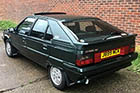
I've never driven a 1.9 Diesel auto but in manual form they're slow but steady sluggers and make surprisingly good "creepers" in slow-moving commuter traffic. The engine has potential to be long-lived if the cooling system is properly maintained, and it hasn't come to you "pre-cooked" (all BX models bar the GTi and 16v lack a proper temp gauge).
Diesel autos do pop up from time to time, and may quite possibly have had a careful owner - ditto 1.6 autos and the non-Gti 1.9 petrol autos. The TRi/TZi estates shared the GTi's engine and trim, and some came in auto form. Nice cars even if you don't like estates, but they're rather scarce.
South London? Pretty big area - though if you do regularly go down the M23 you could check out a company called Carprep in Redhill on the specialists list on this site.
http://www.carprep.co.uk/index.htm
Their quoted labour rate from their website is £45 per hour. I have no knowledge of them other than their inclusion in the list. Some on this list may sell BXs from time to time, or know customers who want to sell - a bonus, as such cars should have evidence of being looked after - and used.
I'd beg to differ from Roverman here when he says of the suspension
As for the suspension most of the jobs any decent mechanic will be able to undertake
Some suspension jobs as above, yes, but the hydraulics in general? Ask "any decent mechanic" who doesn't normally service these cars to quote for changing an octopus return-pipe assembly, replacing the four front-to-rear hydraulic pipes or one of the major hydraulic components and see what kind of quote you get and their degree of enthusiasm for it..... what does your guy say about BXs?
The parts aren't necessarily expensive, but the labour-time to do it may be and often the only people who'll agree to do it are specialists if you're not doing it yourself. If you've owned a CX you must know that already...
Sphere changes, however only need
(1) The spheres themselves (hopefully still around cheaply at Eurocarparts, and German Swedish and French, as well as other sources)
(2) a 12mm spanner
(3) a £15-ish sphere removal tool and the spanner/wrench to tighten it up
(4) a jack and stands (for the rear ones, or possibly the accumulator, depending on model)
(5) an ability to follow instructions, and
(6) most importantly, a willingness to get your hands dirty
Other hydraulic work varies from straightforward through time-munching and neck-cricking up to "needs-considerable-time-enthusiasm and-expertise" (or money if you're paying someone else to do it). A well-maintained and regularly used car pays dividends on that front.
Back on two wheels and pedal power for the moment.
 but judging by the supurb content on this board I would think that could be dealt with later.

 )
)