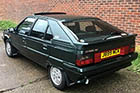
The GS:
I'm not blinkered to the fact that this car has some serious structural design flaws (ie mud traps) which, along with the fact that many of them were made with poor quality steel, has meant that the vast majority have rusted to bu&&ery, and today's survivors are only here because a) they have been pampered and regularly rustproofed from new, or b) they have had major structural and bodywork repairs. The inescapable fact was that they, like the Lancia Beta and other 70s Italian and French metal, were not up to the rigours of the UK climate - especially the salted winter roads - and accordingly started to fall apart at 5 years old, or even less in cases.
This - coupled with the fact that some of the mechanical repairs were rather daunting and expensive (like the CX, to change the clutch is an engine-out job), gave the cars a very poor reputation among Citroen dealers, who increasingly didn't want to know. Many cars got scrapped because of the prohibitive cost of repairs. My girlfriend's dad recounted to me recently how he used to see Citroen dealerships littered with seemingly abandoned GS and GSAs in their yards. By the late 80s, resale values were rock bottom. I recently read about the GS/GSA in the c.1989 Parkers Old Car price guide, which gave the cars a less than complimentary write-up. The equivalent of my car, a 1982 GSA Special Estate, would only have been worth £375ish even in top A1 condition.
For a long time, values have remained poor, and sometimes it's seemed that even half decent examples couldn't even be "given away". More recently there has been an upward trend, however. The best examples now reach £1000 plus, and asking prices for the very best have begun to hit £2000-3500.... although I've yet to hear of a car selling for this sort of sum. My own estate was valued last year by my insurers at £3750.
Here are some of my plus and minus points (based on my experience and also probably re-churning out what other people have said):
Plus
===
The engines feel unburstable and are rev-happy, making that distinctive flat-four burble that only becomes noisy when pushed. They are often called underpowered, as the largest engine is only 1299cc and puts out 65hp, but they are no slouch. The 5 speed GSA will pull 100mph easily, without straining and feels as though it has more to give. It's a very smooth, quiet motorway driver, and easily keeps up with modern traffic. The very best engine is the early GSA "red label" engine circa 1980-82, because the later "ECO" engine has revised inlet ports or something and looses a bit of oomph in the name of "increased economy".
The car's ride is fantastic, akin to the CX and DS. No McPherson struts here! Centre-point steering geometry too with the inboard front discs.
It's aircooled, so no radiator, coolant, water pump, pump belt, head gasket. Basically a bit less to go wrong! And the faster you go, the greater the "ram-feed" effect of the cooling fan, which like the 2CV et al is bolted directly to the front of the crankshaft.
Interior comfort is very good, plenty of room (although as a 6-footer, I find the front seats don't go back as far as I'd like, compared to the BX), fantastic dashboard and ergonomics. Opinion is divided over whether the GS or GSA dashboard is the most desireable - but the GSA heating system wins hands down. The GS system is still pretty good though, it heats pretty quickly in winter - the main thing that lets it down is the fact that the fan has only one speed, and there's no central vents like there are on the BX. The side fresh air vents on the GS and GSA are very powerful - on the motorway, you don't need the window open. But in summer I really notice when I've come off the motorway and sit in traffic. Phew.... open the windows put the cooling fan on full etc...
The non-assisted steering is a little heavy at parking speed, but is light and direct on the move. The GS/A has a far superior turning circle to the BX! With a good set of skinny 145R15 Michelins, the car handles & corners extremely well, including wet conditions. Eminently chuckable

IMHO the look of the car, like the CX and DS, is stunning. There's nothing else quite like it. The GS wins points for its chrome bumpers and door handles over the GSA's clumsy and easily-weathered plastic versions.
Hydraulic system is nice and simple (relatively!!) akin to the DS. No octopus, no flow distributor, no PAS ram etc. No hydraulic belt even, because the pump is directly driven via a connecting rod from the oil pump eccentric. Accumulator sphere is a doddle to change because it sits on top of the engine!!
Minus
====
Rust, rust and more rust. If you cannot weld (like me) then you are forced to take it to a garage for repairs. Panels are still in relatively good supply (mainly due to the amount of scrapped and dismantled vehicles), and now Chevronics do remanufactured sills and floor panels. Rust can be cut out and patches welded in, but the best repair is to replace a whole panel. The cost of which can be prohibitive if carried out to a professional standard. I am in a lot of debt because of the bodywork/structural repairs done to my car

Exhaust blows. The exhaust is a design flaw and is a pig to set up correctly without some kind of leak somewhere. The Y-pipe to front pipe connections are especially bad and access is difficult anyway

Some of the OE front section pipes/manifolds are hard to get hold of now, and pattern items are sh1t as I have learnt to my cost!
Misfiring/flat spots. The carburettor is notorious for running faults. Some people say the Solex is better, some the Weber. When set up correctly, the car is heavenly to drive. Mine is prone to jet blockages (crud from tank) which makes it a pig in traffic. Thankfully at the moment it's behaving 100%
Poor engine bay access. Things like spark-plug removal or changing the alternator (or its belt) are highly involved knuckle scraping and swearword inducing activities. Ditto removing the heater box, starter motor, front brake pads.
Having twin camshafts means it has *two* cambelts. Similarly if either one of these snaps, it means bad news for the valves & pistons. One of the first jobs to do when buying a GS without service history. Or even with. But the front panel, bumper, etc etc are a bugger to remove if it hasn't all been shifted since circa 1985.....
Oil leaks. Can drive you crazy. A good idea to replace all engine seals including oil cooler and oil sump return pipe seals (which are the main culprits due to the v high temperatures - they perish - but the new ones, taking advantage of technological advances, are made of neoprene rubber and accordingly last longer). Again to replace the rear crankshaft seal requires engine removal.
Fuel economy. Not the best for a small-engined car. If careful, you can get 35-40+ mpg on motorway runs, but in town traffic this figure can plummet. The C-matic is worse.... although this is a joy to drive in town traffic in comparison. The manual has poor low down torque, and can be jerky in slow traffic, with lots of clutch slipping, gearstick stirring etc. - especially in uphill traffic -which is not so much of a problem with the C-matic, which you can leave in "2nd" and just creep along

Tyres. Michelin 145SR15's are not widely available and are expensive (roughly £45 each), but were designed for the car. Firestones are more widely available but wear worryingly fast in my experience. Apparently you can get Kleber 155s... anyway the tyre situation is a bit of a worry for most GS owners.
Driveshafts. A weak point - CV joints are prone to fail because of the strange forces acting upon them (due in part to the long travel suspension and the inboard brakes) and if the inner joint goes, it could fubar the gearbox...
Unlike the BX, there is no "low" position... which I miss. You have to manually release pressure through valves - one under the bonnet, one under an inspection panel in the boot.
Rear spheres. Can be a big pain to remove, and strut pipes can be twisted or fractured in the process..... Less of a problem if they've been changed at the first sign of loosing pressure, rather than being left for years on end until they're completely flat

There's probably more I can add, but I want to go home! I hope it gives an idea anyway
Cheers,
Mark.